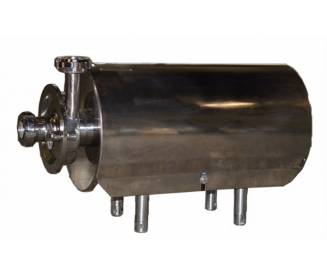
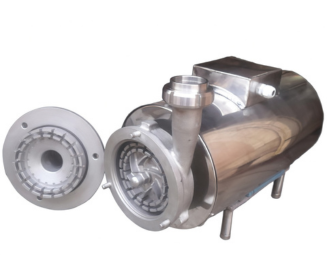
Rotary Lobe Pumps vs Centrifugal Pumps: Understanding the Key Differences
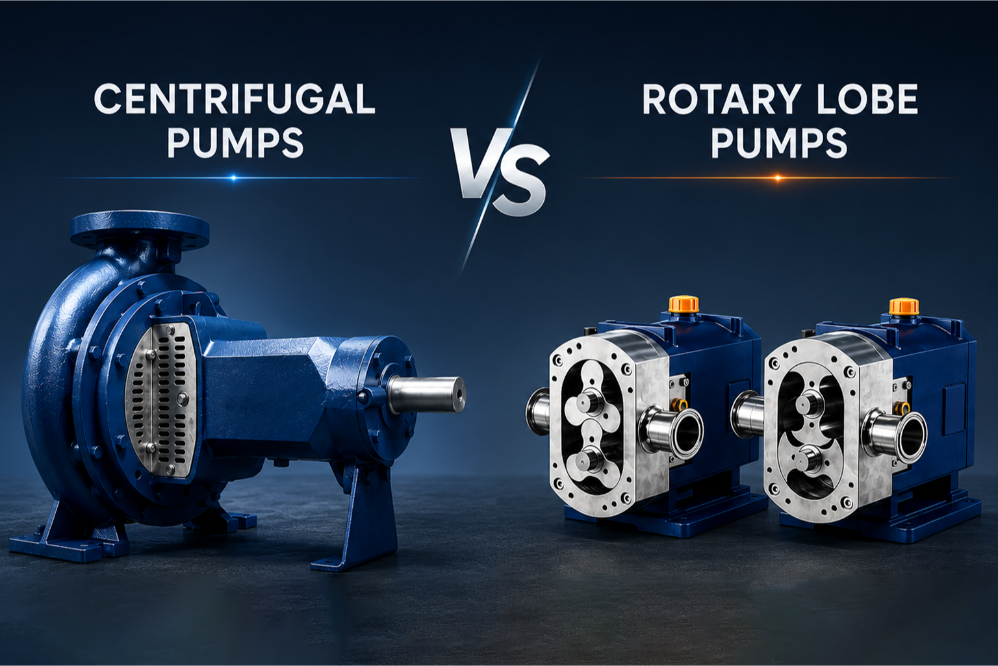
Choosing between a rotary lobe pump and a centrifugal pump isn't about finding which technology is better—it's about selecting the right pump for your process. Both are widely used across industrial manufacturing, but each is designed to handle different fluid characteristics, operating conditions, and production requirements.
If you're evaluating industrial Rotary Lobe Pumps for hygienic processing or viscous fluid handling, understanding how they compare with centrifugal pumps will help you make a more informed equipment selection before investing in a pumping system.
While centrifugal pumps are commonly used for transferring low-viscosity liquids at high flow rates, rotary lobe pumps are engineered for applications that demand gentle product handling, consistent flow, and hygienic operation. Knowing these differences can improve production efficiency, protect product quality, and reduce long-term operating costs.
This guide compares both pump technologies, explains where each performs best, and highlights the key factors engineers, plant managers, and procurement professionals should consider when selecting the right pump for their application.
Rotary Lobe Pumps vs Centrifugal Pumps: What's the Difference?
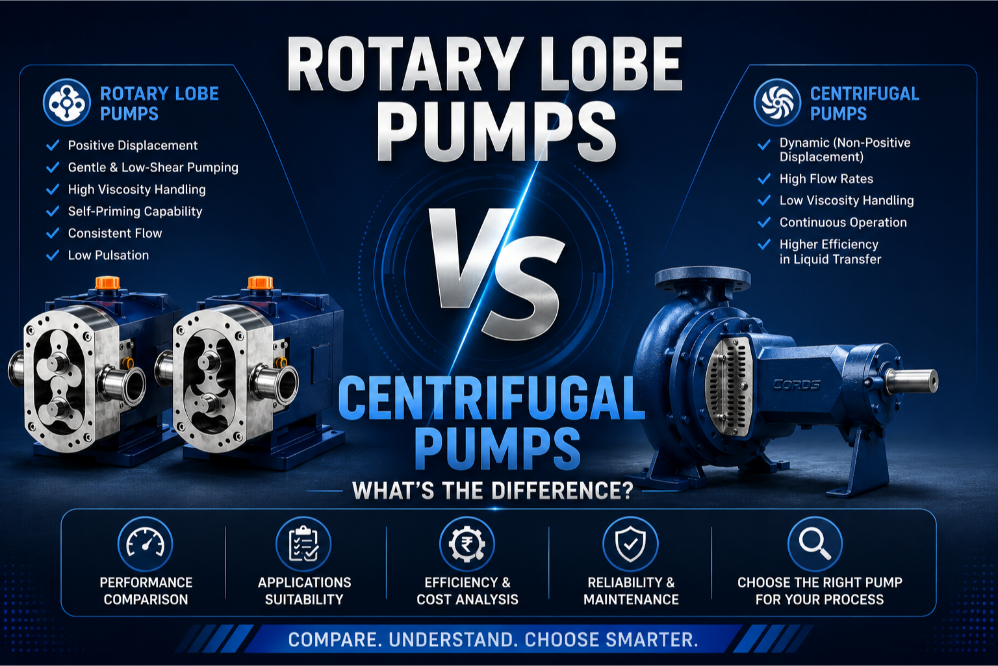
Although both rotary lobe pumps and centrifugal pumps are designed to transfer fluids, they operate using completely different pumping principles. These differences influence how each pump handles viscosity, pressure, product sensitivity, and overall process efficiency.
Understanding the operating principle behind each technology helps engineers and procurement teams select equipment that matches their production requirements instead of relying solely on flow rate or purchase cost.
Understanding Positive Displacement Rotary Lobe Pumps
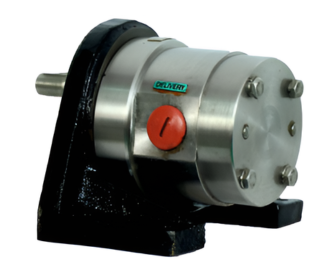
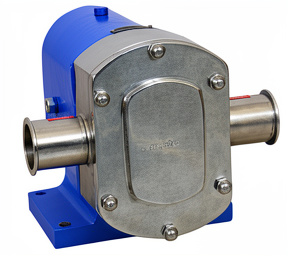
A rotary lobe pump is a positive displacement pump that moves a fixed volume of liquid during every rotor revolution. Two synchronized lobes rotate without touching each other, creating sealed cavities that transport the product smoothly from the inlet to the outlet.
This pumping method delivers a consistent flow while minimizing shear, making rotary lobe pumps suitable for handling viscous liquids, delicate products, and fluids containing soft solids. Their hygienic construction also makes them a preferred choice in food, dairy, pharmaceutical, cosmetic, and biotechnology processing.
How Centrifugal Pumps Transfer Fluids
A centrifugal pump operates using a rapidly rotating impeller that converts mechanical energy into fluid velocity. As the liquid enters the impeller, centrifugal force pushes it toward the discharge outlet, producing continuous flow throughout the system.
This operating principle makes centrifugal pumps highly effective for transferring clean, low-viscosity liquids at high flow rates. They are commonly used in water distribution, cooling systems, general chemical transfer, and other industrial applications where gentle product handling is not the primary requirement.
Understanding the Fundamental Difference Between Both Technologies
The biggest difference between rotary lobe pumps and centrifugal pumps lies in how they move fluid and the applications they are designed to serve. Rotary lobe pumps prioritize controlled flow, hygienic operation, and gentle handling of viscous or shear-sensitive products, while centrifugal pumps focus on efficiently transferring large volumes of low-viscosity liquids.
If you're evaluating where rotary lobe pumps are used across different industries and why manufacturers choose them for hygienic processing, explore our detailed guide covering industrial applications, fluid compatibility, and sector-specific use cases before selecting the right pumping technology.Performance Comparison: Which Pump Performs Better?
There isn't a single pump that performs better in every application. The right choice depends on the type of fluid being handled, the required flow rate, operating pressure, and the overall process requirements. Understanding these performance differences helps manufacturers choose equipment that delivers reliable operation and long-term value.
While centrifugal pumps are ideal for transferring large volumes of low-viscosity liquids, rotary lobe pumps excel in applications that demand precise flow, hygienic design, and gentle product handling. Comparing these characteristics helps identify the most suitable pumping technology for your production process.
Handling High-Viscosity Fluids
One of the biggest performance differences between the two technologies is their ability to handle viscous products. Rotary lobe pumps maintain a consistent flow even when transferring thick fluids such as honey, chocolate, creams, syrups, fruit pulp, cosmetic emulsions, sludge, and specialty chemicals.
Centrifugal pumps generally perform best with low-viscosity liquids like water, solvents, and thin chemical solutions. As fluid viscosity increases, pump efficiency can decrease, making them less suitable for applications involving dense or highly viscous products.
Flow Rate, Pressure & Energy Efficiency
Centrifugal pumps are often selected for applications requiring high flow rates and continuous movement of low-viscosity liquids. Their simple design makes them a practical solution for water circulation, cooling systems, and general industrial fluid transfer.
Rotary lobe pumps, on the other hand, provide a controlled and predictable flow regardless of changes in product viscosity. This stable performance helps improve dosing accuracy, maintain process consistency, and reduce product loss in applications where precision is more important than maximum flow volume.
Product Quality & Low-Shear Performance
When handling products that can be damaged during pumping, low-shear performance becomes a critical selection factor. Rotary lobe pumps are designed to move delicate fluids with minimal mechanical stress, helping preserve product texture, consistency, and quality throughout the production process.
For applications involving yoghurt, dairy products, pharmaceutical formulations, cosmetic creams, sauces, fruit preparations, or other shear-sensitive products, this gentle pumping action can contribute to better product integrity and more consistent manufacturing results. In contrast, centrifugal pumps are generally better suited to products that are less sensitive to turbulence and shear.
When Should You Choose a Rotary Lobe Pump Instead of a Centrifugal Pump?
The right pump depends on the fluid being transferred, the production environment, and the performance expected from the system. While centrifugal pumps are an efficient solution for moving large volumes of clean, low-viscosity liquids, rotary lobe pumps become the preferred choice when hygiene, product protection, and handling difficult fluids are critical requirements.
For industries where product quality, sanitary operation, and process consistency directly impact production, choosing the correct pumping technology can improve efficiency while reducing maintenance and operational costs.
Applications Requiring Hygienic Pumping
Industries operating under strict hygiene regulations require equipment that can be cleaned thoroughly while minimizing contamination risks. Rotary lobe pumps are specifically designed for sanitary processing environments, making them suitable for food manufacturing, dairy processing, beverage production, pharmaceutical manufacturing, biotechnology, and cosmetic production.
Their stainless steel construction, smooth internal surfaces, and compatibility with Clean-in-Place (CIP) and Sterilize-in-Place (SIP) systems help maintain hygienic production standards while reducing cleaning time between production cycles.
Processes Handling Delicate or High-Viscosity Products
When products are sensitive to excessive shear or contain soft solids, selecting the right pumping technology becomes essential. Rotary lobe pumps provide controlled, low-pulsation flow that helps preserve product texture, consistency, and overall quality throughout the transfer process.
They are widely used for handling products such as yoghurt, cream, chocolate, honey, sauces, fruit pulp, pharmaceutical gels, cosmetic emulsions, and specialty chemicals where gentle fluid handling contributes to better manufacturing results and reduced product loss.
Explore Rotary Lobe Pumps for Industrial Applications
If your process requires hygienic construction, reliable positive displacement performance, or efficient handling of viscous and shear-sensitive products, a rotary lobe pump is often the most suitable solution. Evaluating pump capacity, construction materials, operating pressure, and application requirements helps ensure long-term performance and process reliability.
Explore our range of Rotary Lobe Pumps to compare hygienic designs, technical specifications, and application-specific models engineered for food, dairy, pharmaceutical, cosmetic, biotechnology, and chemical industries.
Making the Right Pump Selection for Long-Term Performance
Choosing between a rotary lobe pump and a centrifugal pump should be based on your application's operating requirements rather than on initial purchase cost alone. Factors such as fluid viscosity, hygiene standards, flow consistency, operating pressure, and maintenance requirements all influence long-term pump performance and overall production efficiency.
By evaluating these requirements before selecting a pump, manufacturers can reduce operating costs, improve equipment reliability, and ensure consistent product quality throughout the production process.
Evaluate Your Process Requirements
Every industrial application presents different pumping challenges. Before selecting a pump, it's important to assess the type of fluid being handled, its viscosity, operating temperature, required flow rate, discharge pressure, and whether the process involves shear-sensitive or particle-containing products.
Matching these process conditions with the appropriate pumping technology helps improve system performance, extend equipment life, and reduce unexpected maintenance or production downtime.
Compare Performance Beyond Initial Cost
While the purchase price is an important consideration, the total cost of ownership often has a greater impact on long-term profitability. Energy efficiency, maintenance frequency, spare part availability, product recovery, cleaning requirements, and operational reliability all contribute to the overall value of a pumping system.
Selecting equipment based on long-term process performance rather than upfront investment helps manufacturers achieve greater productivity while minimizing lifecycle costs.
Learn More About Rotary Lobe Pump Technology
Selecting the right pump starts with understanding how the technology works and where it performs best. Once you've compared rotary lobe pumps with centrifugal pumps, gaining a broader understanding of their operating principle, applications, and selection factors can help you make a more confident engineering decision.
Read our complete guide to Rotary Lobe Pumps to explore how positive displacement technology works, where it is commonly used, and the key considerations for selecting the right pump for different industrial applications.
Ready to Select the Right Pump?
Our engineers can help you choose the correct rotary lobe pump model based on your fluid, flow, pressure, and hygiene requirements.
View EP Series